Page 2 of 4
Re: VemsNewb
Posted: Mon Mar 25, 2013 6:41 pm
by pilihp2
Well crap. That throws the tuning I just did to lean it out, out the window.
Re: VemsNewb
Posted: Mon Mar 25, 2013 6:56 pm
by chaloux
That's also what it says in my tuning book.
Re: VemsNewb
Posted: Mon Mar 25, 2013 8:25 pm
by DuBistS4
Okay Hank so I guess you do alot more than just weld

makes alot of sense, thanks for the knowledge Hank!
Re: VemsNewb
Posted: Mon Mar 25, 2013 8:36 pm
by Hank
Lean it out still, but just not above 1 lambda. For instance, on e85, you have zero knock risk at 1.0 lambda at 150kpa due to the fuel burning cooler and the knock resistance, where on gas, you risk light detonation. 150kpa on gas might result in 1600F prolonged EGTS where on e85, you probably won't exceed 1450F, a livable temperature. It would be in the 1350F range if you rich up, but components can take it on street duty.
For track maps, I still use a lot of gas, even in that mid range. It is cheap cooling to keep valves cooler, headers cooler, turbines and seals happy, ect. For hte occasional onramp rip, leaning up can happen on mid range.
On the street, I often ran .93-.96 lambda at 200kpa, tapering down to .85 lambda by 300kpa and left .82Lambda for the WOT. This will save a bunch of gas and put a good amount of hydrocarbon into the atmosphere.

Got Nox?
Terrible, I know. Lots of OEM tunes are not so much to rob power or efficiency, but rather to reduce emissions. Chipping can increase power, torque and spool at the expense of emission
No problem Dubist, I love to learn like everybody else.
Re: VemsNewb
Posted: Mon Mar 25, 2013 9:10 pm
by DuBistS4
So you run .93-.96 at 200kpa on 93 pump gas? What is your setup? Are you running meth? I didnt know you could run that lean at those pressures and not knock.
Re: VemsNewb
Posted: Mon Mar 25, 2013 9:25 pm
by EDIGREG
DuBistS4 wrote:So you run .93-.96 at 200kpa on 93 pump gas? What is your setup? Are you running meth? I didnt know you could run that lean at those pressures and not knock.
NO! That is with E85... don't do that with gasoline!
Re: VemsNewb
Posted: Mon Mar 25, 2013 9:44 pm
by EDIGREG
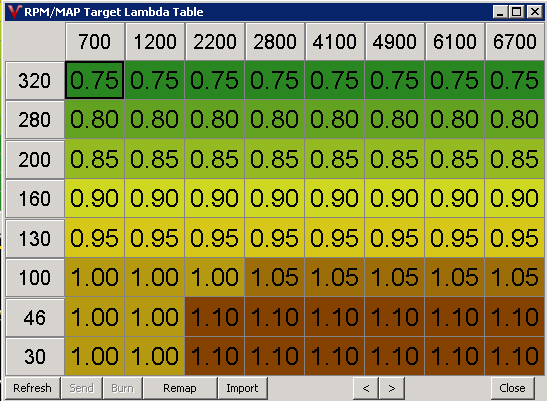
Hank - While I fully agree with your conclusions on paper, I have experienced a significant increase in fuel economy by leaning out closed loop lambda targets under no load/cruising. Your results make sense to me given a constant load, however, with constantly changing road conditions/elevations, the time spent in cruising/boost cells varies. Fuel consumption remains the same during boost/acceleration but saves fuel while cruising.
Experience may differ in the flatter parts of the country where load is fairly constant... very hilly over here
I'm interested in seeing your targets under light/moderate load w/ E85, because as you said that is definitely where the most fuel can be saved.
Re: VemsNewb
Posted: Mon Mar 25, 2013 10:08 pm
by DuBistS4
EDIGREG wrote:DuBistS4 wrote:So you run .93-.96 at 200kpa on 93 pump gas? What is your setup? Are you running meth? I didnt know you could run that lean at those pressures and not knock.
NO! That is with E85... don't do that with gasoline!
LOL Figured

Re: VemsNewb
Posted: Mon Mar 25, 2013 10:22 pm
by DuBistS4
Ed, those targets u just posted are for 93 pump gas? Also, I noticed that many of the guys running MTM 1+ would have mixed reports about how much the engine pinged. What other factors are at work that can make 2 identical motors vary from each other in this situation?
Re: VemsNewb
Posted: Mon Mar 25, 2013 10:26 pm
by chaloux
I'd assume (could be wrong) taht Ed is posting for E85.
Gas grade and quality, altitude, ambient temperatures, spray pattern would all affect combustion.
Re: VemsNewb
Posted: Mon Mar 25, 2013 10:35 pm
by EDIGREG
Not to mention fuel pump and injector condition, intercooler efficiency, etc. There are also 100 different chips out there labeled "MTM1+", most of them are knock offs of the original.
Those are my current E85 lambda targets...could definitely be leaned out in the midsection (couldn't we all

)
Re: VemsNewb
Posted: Tue Mar 26, 2013 12:30 am
by Hank
If I leaned out in my midsection, I would cease to exist....

Ed, Varying load should not matter if the theory is followed. If you need an arbitrary 200hp to maintain 85mph on flat ground, you are going to burn ~509,000 BTU's over 1 hour. If 1 gallon of e85 is 114,000 BTUs, you are going to need about 5 gallons of e85 to maintain that speed at that load(200hp, again arbitrary). The energy is from the fuel, so if you are leaning out the motor to save fuel, you still need 509,000 BTU's to maintain that speed. Increasing the Air to Fuel ratio will show up as leaner on the gauge, but you will have to to give more throttle postition(air) to maintain that speed. The increased air(with increased Fuel) will satisfy the BTU requirements, but the economy will be the same. Unfortunately the motor will be the most efficient at stoic, so Thermal Efficiency will decrease as you venture lean.
In the hills(not to be confused with the mountains we have out west), the theory is the same, just with higher BTU/hp requirements uphill, and less on downhill.
Again, the most gains to be had are with 20-70% TPS inputs with moderate boost. On our FSAE car, this is where Ethanol made the most sense to use as a fuel. for the 20km endurance race, we were only allowed 19.5 MJ regardless of fuel type. By using E85, we would be less efficient on WOT and sustained static cruising, but hte majority of the endurance race was in that midrange where we could run at 1 lambda instead of the .95 lambda required on gas to keep light pinging at bay. We ended up winning that event with the fastest time using hte least amount of our energy lotment( we had 5.5MJ remaining IIRC).
Re: VemsNewb
Posted: Tue Mar 26, 2013 12:46 am
by Hank
oh, and Yes, we are talking about e85 here, NOT GAS!!!!!!
The same can be done with gas, but be very careful and do it with knock detection/phones.
Re: VemsNewb
Posted: Tue Mar 26, 2013 1:08 am
by Hank
Ed,
I'll look at my targets when I get to my computer, but my upper level on mine is 380kpa, and it is set at .80
I think you are over the top safe on e85 in the 130-200kpa range on your car. With a very open exhaust/header/hotside, I think you could get away with lots less fuel in that area and have better economy. The extra fuel will help with spool on spool onset.
Hank
Re: VemsNewb
Posted: Tue Mar 26, 2013 7:56 am
by DuBistS4
Could chasis ears be used as aknock detection tool. Say one clamped directly onto the knock sensor. I recently used one to diag a rattle and it worked really well. I tried Marcs write up but I must have screwed it up or my knock sensor is dead.
Re: VemsNewb
Posted: Tue Mar 26, 2013 8:48 am
by EDIGREG
Your results make perfect sense for load cells, but they don't take into consideration the time where the minimum energy is required only to keep the engine running, vacuum/off-throttle/uber low-load cruising. As soon as you hit ~5-10% TPS you're making at least atmospheric pressure and you're back into the "normal" lambda targets.
I don't know how else to quantify my results. I know Chris and some others have had similar experiences by simply leaning out load cells under 100kPa.
Re: VemsNewb
Posted: Tue Mar 26, 2013 9:00 am
by EDIGREG
Hank wrote:Ed,
I'll look at my targets when I get to my computer, but my upper level on mine is 380kpa, and it is set at .80
I think you are over the top safe on e85 in the 130-200kpa range on your car. With a very open exhaust/header/hotside, I think you could get away with lots less fuel in that area and have better economy. The extra fuel will help with spool on spool onset.
Hank
Man, .80 at 380kPa seems crazy to me! Maybe my habits have just been tainted by tuning with gasoline. Also, from what Marc was telling me, E85 makes more power leaving it on the slightly richer side.
Definitely seems very safe in the mid-section, interested to see what your targets are.
Re: VemsNewb
Posted: Tue Mar 26, 2013 9:31 am
by Marc
EDIGREG wrote:Hank wrote:Ed,
I'll look at my targets when I get to my computer, but my upper level on mine is 380kpa, and it is set at .80
I think you are over the top safe on e85 in the 130-200kpa range on your car. With a very open exhaust/header/hotside, I think you could get away with lots less fuel in that area and have better economy. The extra fuel will help with spool on spool onset.
Hank
Man, .80 at 380kPa seems crazy to me! Maybe my habits have just been tainted by tuning with gasoline. Also, from what Marc was telling me, E85 makes more power leaving it on the slightly richer side.
Definitely seems very safe in the mid-section, interested to see what your targets are.
.8 is where I target e85 stuff now. seems to make more power and have plenty of det resistance, even at high boost.
Re: VemsNewb
Posted: Tue Mar 26, 2013 9:39 am
by Hank
Yeah, but decel is decel. That should be killing injector PW all together.
The testing on the FSAE car was NA testing from 35kpa to 100 kpa in 10 kpa increments at .80 lambda-1.15 lamda in .03 increments from 1500-12500 rpm. On the university Land and Sea chassis dyno, we could vary load and did such in 4 different loads simulations. We took a graduated cylinder and made a rig so we could accurately measure out fuel consumption over a 10 minute period at those variables. Ignition timing was also optimized before hand (Thus the 40 hours on the dyno figure) for each lambda and load setting. We also tested on 91 octane and e85 for all variables. While EGT's were obviously much higher at 1 lambda, that is where the most power was produced per BTU expended. In some instances at WOT, slightly rich of around .97 Lambda would make slightly more power with equivalent consumption, but that was only with gasoline.
I'll dig up the charts and data behind the testing. I have it on a thumb drive somewhere in my "school box" I tried to forget about after college
My Turbocharged experience with e85 is that it won't physically light off 380kpa worth of fuel at .75 lambda. Furthermore, I find that I make the most power at .83-.84 levels, but at the expense of high EGTs. .8-.82 is a level I can get clean pulls without rich misfires, and still keep EGT's safe and sound.
Re: VemsNewb
Posted: Tue Mar 26, 2013 11:53 am
by DuBistS4
What is the idea behind optimal timing while cruising? Do you want as much timing as possible to increase cyl press and squeez out the most power as possible
Re: VemsNewb
Posted: Tue Mar 26, 2013 11:55 am
by Marc
DuBistS4 wrote:What is the idea behind optimal timing while cruising? Do you want as much timing as possible to increase cyl press and squeez out the most power as possible
Optimum timing is the lowest timing number at which peak power is produced at any given load point. This is referred to as "MBT": Minimum timing for Best Torque. Its easy to do on a dyno. On the road, this can also be done with EGT. this point of optimum power also happens to correspond to the lowest EGT numbers as well. But, from experience its way easier to do it with dyno feedback than just EGT.
Re: VemsNewb
Posted: Tue Mar 26, 2013 12:04 pm
by DuBistS4
More timing= Higher EGT Less timing=lower egt?
Re: VemsNewb
Posted: Tue Mar 26, 2013 12:04 pm
by chaloux
Will, you can glean a lot of info from forums like this and other online resources, but I suggest picking up a book that you can reference and learn and understand some of the basic fundamental ideas around combustion and tuning. It sounds dumb but Greg banish's "engine management, advanced tuning" helped me a lot. It makes understanding what these guys are talking about a lot easier, and you can obviously apply it to your own car and see the theory confirmed.
Of course you can just keep this thread going as well
Re: VemsNewb
Posted: Tue Mar 26, 2013 12:07 pm
by chaloux
More fuel and more timing both lower egt. But timing also brings you closer to the knock limit. It's an act of balancing a few key factors for optimum performance
Re: VemsNewb
Posted: Tue Mar 26, 2013 12:21 pm
by DuBistS4
Agreed. I actually have that book and read it, I just wanted to know what other peoples experiences were and from that decide based on my tuning experince whats actually true. Thats why I started this thread here, I think Marc, Ed and Hank have extensive knowledge from experience. Most other forums and internet sources people just regurgitate what they have heard true or not and dont test it themselves. I do have a good understanding of fuel injection and engine theory but sometimes the theories are just that..theories so I try and ask questions I think I no answers to but am not sure of. Thats all